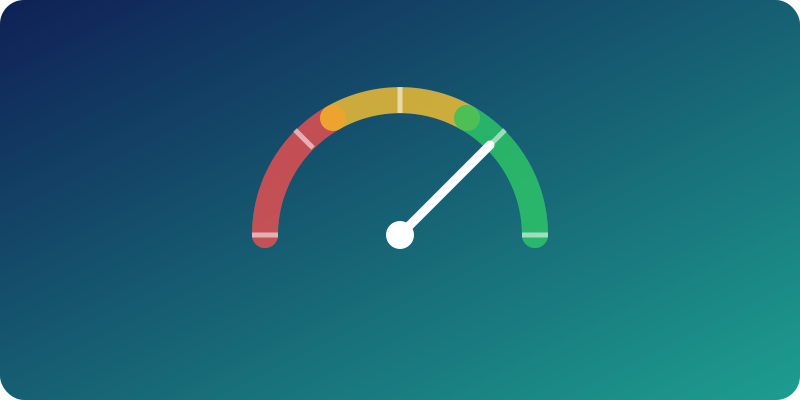
Most people check their CIBIL score only after a bank rejects their loan. That is the wrong order. Your credit score is the first filter every lender applies — before they look at your income, your property, or your business turnover. In 2026, checking your score free of cost takes under five minutes. There is no excuse not to know where you stand.
Let me explain what the number actually means in practical terms — not the marketing language you see on fintech apps.
How to Do a CIBIL Score Check Free in 2026
TransUnion CIBIL allows one free credit report per year through their official website. Go to cibil.com, click on 'Get Free CIBIL Score', and complete the verification using your PAN and Aadhaar OTP. You will see your score and a summary of your credit accounts within minutes.
Apart from CIBIL, platforms like Paytm, BankBazaar, OneScore, and Bajaj Finserv Markets also show your credit score free — some use CIBIL data, others use CRIF or Experian. The score may vary slightly between bureaus, but all four are recognised by Indian lenders. Checking your own score is a soft enquiry and does NOT reduce your score — a common myth that stops people from checking regularly.
Make it a habit: check your score every 3–4 months, especially if you are planning a loan in the next 6–12 months. Use the tips in our guide on how to improve CIBIL score if you find anything pulling your number down.
CIBIL Score Bands and What They Mean for Your Loan in 2026
Your score runs from 300 to 900. Here is what each range realistically means when you walk into a bank or apply online:
- 750–900 (Excellent): Best interest rates, fast processing, higher loan amounts. Banks compete for your file. Home loan rates can start at 8.50% p.a., personal loans at 10.50% p.a.
- 700–749 (Good): Most lenders will approve you, but you may not get the headline rate. Expect 0.25–0.50% premium over the best rate. Minor negotiation is still possible.
- 650–699 (Fair): PSU banks may hesitate. NBFCs and private banks will still lend but at higher rates. Loan amounts may be capped. A co-applicant with a better score helps significantly.
- 600–649 (Poor): Limited to select NBFCs and fintechs at high rates (18–24% p.a. for personal loans). Home loans are very difficult at this range. Focus on rebuilding first.
- Below 600 (Very Poor): Mainstream lending is largely closed. Secured products (loan against FD or gold) are your best options while you rebuild.
Check your personal loan eligibility alongside your score — many calculators now factor in score bands to give a realistic picture.
What Pulls Your CIBIL Score Down: The Real Culprits
Payment history accounts for roughly 35% of your score. One missed EMI does not destroy your credit — but a 90-day overdue entry stays on your report for 7 years and will block you from prime lenders. This is the single biggest risk people underestimate.
Credit utilisation is the second major factor. If your combined credit card limit is ₹2 lakh and your outstanding balance is ₹1.8 lakh, your utilisation is 90% — which signals financial stress to lenders even if you pay on time. Keeping utilisation below 30% consistently improves your score faster than almost anything else.
Multiple loan enquiries in a short window also hurt. Every time a bank pulls your CIBIL report for a hard enquiry (loan or card application), it knocks a few points off. Applying to 5 banks simultaneously in the hope that one approves does more damage than most borrowers realise. A DSA applies to the right lender the first time, protecting your score — see why use a loan agent for more on this.
Building Your Score Before a Big Loan Application in 2026
If you are planning a home loan or business loan in the next 6–12 months, start working on your score now. The moves that have the fastest impact: pay every EMI on time without exception, reduce credit card balances aggressively, and dispute any incorrect entries on your credit report through CIBIL's online dispute portal.
Adding a secured credit card (against an FD of ₹15,000–₹25,000) is an underused strategy for people with thin credit files. It builds positive payment history without requiring existing credit. Within 6 months of disciplined use, scores typically move up 30–50 points.
Also run our EMI calculator to see what loan amount and tenure makes sense given your current income — sometimes waiting 6 months to improve your score is worth ₹2–3 lakh in interest savings over the loan tenure.
Frequently Asked Questions
Does checking my CIBIL score free reduce it?
No. Checking your own score is classified as a soft enquiry and has zero impact on your credit score. Only hard enquiries — when a bank or lender pulls your report for a loan application — affect your score. Check freely and regularly.
How often does CIBIL update the score?
CIBIL updates scores every 30–45 days based on data reported by member banks and NBFCs. So if you close a loan or reduce your credit card balance today, the improvement will reflect in your score within 30–45 days in most cases.
My CIBIL score shows -1 or 0. What does that mean?
A score of -1 means you have no credit history at all — no loans, no credit cards, nothing reported to any bureau. A score of 0 typically means less than 6 months of credit history. This is a thin file, not a bad file. Lenders can still approve you, but they may charge a slight premium or ask for a co-applicant. Building a credit history with a secured card or a small consumer loan is the fastest fix.
Know your score, fix what needs fixing, and apply with confidence. When you are ready, apply for a loan through Guhan Capitals — we review your credit profile before submitting your file and match you with lenders who are most likely to approve at the best rate.